
KZ Porschdorf Sub‑Camp
“In Porschdorf we found a camp that had just been built, far from the village. It was located in a narrow valley that was no wider than 100 metres. The barracks were situated under a cliff face that served as the roof. Water dripped continuously, and it was incredibly damp. […] This became the place of our torment.”
[Ugo Bigardi in Anna Chilesotti; Giacomo Chilesotti: Campo di annientamento e morte di Giuliano. Padua, Zanocco. 1947. P. 159-163.]
KZ Porschdorf Sub‑Camp
In the Polenz Valley, from early February until mid‑April 1945, there was a sub‑camp of the concentration camp Flossenbürg. It operated under the code name “Schwalbe III” and belonged to a project intended to secure the production of aviation gasoline for the German air force. The camp complex and construction sites stretched from Ochelbaude (map No.10) to the Waltersdorfer Mill. The two and a half months during which the camp existed, and subsequent death march, claimed many of the 250 prisoners’ lives.
Two further sub‑camps were located at Königstein and Pirna‑Mockethal. Planning and construction of the three camps were overseen by the engineering office of Prof. Rimpl from Königstein.
Flossenbürg Sub‑Camp System and Underground Relocation of Industry
The three sub‑camps in Saxon Switzerland, housing thousands of concentration‑camp inmates, forced labourers and prisoners of war, were part of a wide network. Flossenbürg alone had roughly 80 sub‑camps. All camps in Saxon Switzerland were created to facilitate the underground relocation of industrial facilities. The Nazi leadership pursued this strategy in response to increasing Allied bombing of cities and the advance of the Red Army. Civilian companies were heavily involved in planning and executing these projects, including the use of concentration‑camp prisoners.
The Schwalbe III Camp
On 3 February 1945, 250 prisoners from the main Flossenbürg camp were transferred to Porschdorf, most of them Italians. They were housed in barracks along a bend of the Sebnitz stream (map No.8). The prisoners could enter the barracks only to sleep; today little remains of them. The prisoner kitchen was demolished in the late 1990s. Guard detachments were stationed at Ochelbaude (map No.10), and the nearby climbing rock face “Bahnhofswächter” also served as a guard post. Prisoners had to walk up to half an hour each day to reach work. Their labour included quarry work at Ochelbaude, unloading barges on the Elbe, and above all work in the Polenz Valley. There they built a railway embankment—still clearly visible today—along which the present‑day hiking trail to the Waltersdorfer Mill runs. They also had to drive tunnels into the rock faces, but these only reached a few metres in depth before the camp was dissolved. Concrete plinths (map No.2) that remain today were used for mounting compressors.
Dissolution of the Camp
Although the camp existed for only a few months, some prisoners died there; according to the camp’s register, nine deaths were recorded. As in many other camps, gravely ill and exhausted prisoners were frequently transferred elsewhere, where they later died. Far more prisoners perished during the subsequent death march. The march began on 16 April 1945, moving from Porschdorf through Hellendorf in the Bahratal and ending after two to three days at a farm in Oelsen near Bad Gottleuba. Survivors were quartered in a barn and forced to fell trees to build tank barriers. On 9 May they were liberated by the Red Army; the German guards had fled the day before.
Legal Aftermath
After the war, the Kassel public prosecutor’s office investigated Gustav Göttling, the former commandant of the Porschdorf camp. Because the primarily Italian witnesses could not identify any perpetrators and Göttling denied all wrongdoing, the case was closed in December 1977.
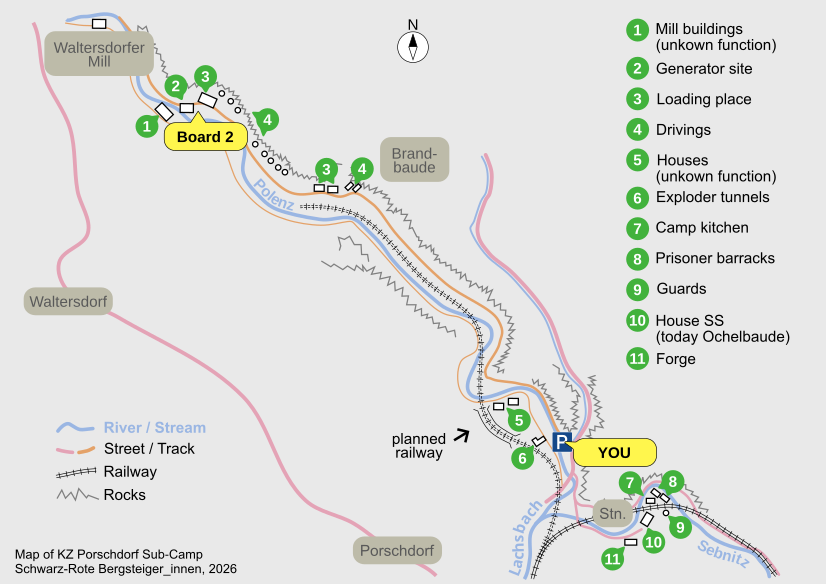
Another information board about the history of a prisoner can be found at the historic foundations (see map "Board 2").